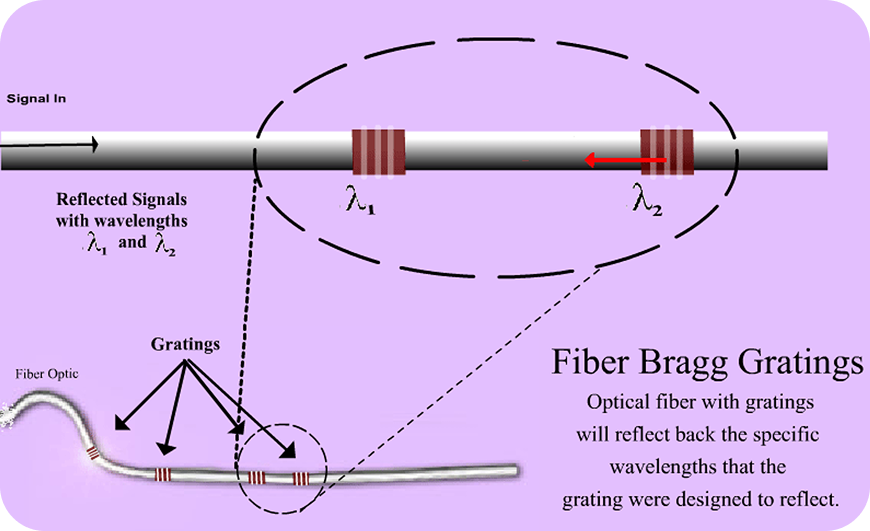
Avolution Tech delivers advanced Fiber Bragg Grating (FBG) sensor technology designed specifically for structural health monitoring and asset management. Our solutions are trusted by industry leaders—deployed by Boeing for strain and temperature monitoring in aircraft structures, and by VicRoads on the Westgate Bridge in Melbourne, a critical transport artery, for continuous infrastructure assessment. These real-world applications highlight the effectiveness and reliability of FBG sensors in safeguarding high-value assets. By implementing this technology, we aim to help you enhance safety, improve operational efficiency, and extend the lifespan of your infrastructure.
How FBG Sensors Work in Bridges and Infrastructure
Introduction
Avolution Tech delivers advanced Fiber Bragg Grating (FBG) sensor technology designed specifically for structural health monitoring and asset management. Our solutions are trusted by industry leaders—deployed by Boeing for strain and temperature monitoring in aircraft structures, and by VicRoads on the Westgate Bridge in Melbourne, a critical transport artery, for continuous infrastructure assessment. These real-world applications highlight the effectiveness and reliability of FBG sensors in safeguarding high-value assets. By implementing this technology, we aim to help you enhance safety, improve operational efficiency, and extend the lifespan of your infrastructure.
Unlike conventional strain gauges, FBG sensors provide continuous, remote monitoring with exceptional durability and resistance to electromagnetic interference. Their advanced sensing capabilities allow for proactive maintenance strategies, extending the lifespan of infrastructure and significantly reducing operational costs.
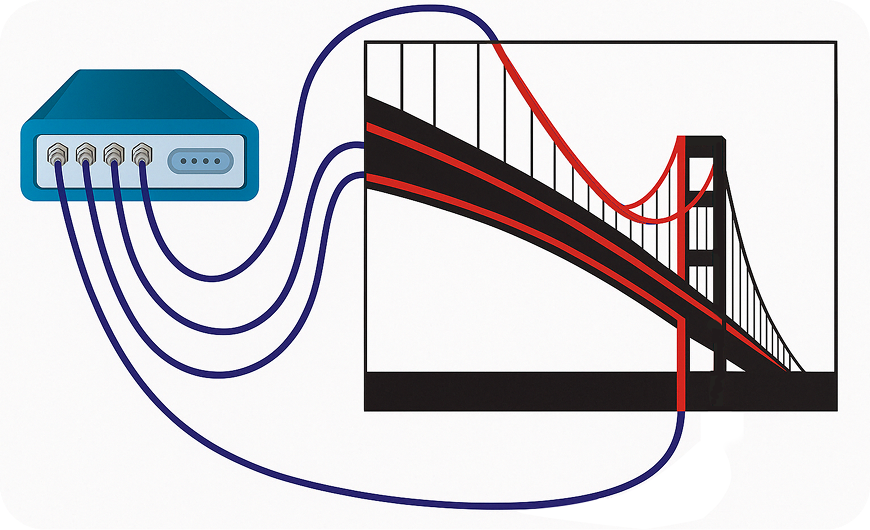
Real-world deployments—such as on the Westgate Bridge in Melbourne—demonstrate how FBG technology enhances safety and reliability by facilitating early detection and intervention. Designed for harsh environments and offering long-term data stability, FBG sensors have emerged as the gold standard in global structural health monitoring.
Our Solutions
Our SolutionsAsset Management with FBG Sensors
FBG sensors enable real-time monitoring of strain, temperature, and vibration within structural systems, delivering significantly enhanced performance compared to traditional monitoring methods. Our solution provides precise, actionable insights that empower proactive maintenance strategies and effective risk management, helping to ensure the long-term integrity and reliability of your assets.
Sensor Deployment
Signal Processing Unit
Data Aggregation
Why FBG Sensors?
High Sensitivity
Detect minute changes in structural integrity, temperature, and stress.
Durability & Reliability
Detect minute changes in structural integrity, temperature, and stress.
Long term monitoring
Monitoring can be spanned to a long period for observing structural changes and degradation.
Scalable & Flexible
Ideal for diverse applications including bridges, buildings, pipelines, and aerospace components.
Key Business Benefits
Enhanced Safety & Compliance: Real-time monitoring helps prevent failures, ensuring compliance with safety standards and reducing liability.
Cost Efficiency: You can avoid costly repairs and unplanned downtime by identifying issues early.
Long-Term Monitoring: FBG sensors offer stable, long-term performance with minimal maintenance, perfect for continuous structural health monitoring.
Implementation Timeline
Phase 1: Assessment & Planning
Conduct a comprehensive site evaluation to identify critical monitoring points.
Design a customized FBG sensor network tailored to your specific infrastructure needs.
Phase 2: Deployment & Integration
Deploy and configure FBG sensors on identified assets
Integrate sensor data into a centralized monitoring platform, accessible via a secure web interface or mobile app.
Phase 3: Monitoring & Maintenance
Provide continuous monitoring with real-time alerts for any anomalies detected.
Offer periodic maintenance and calibration services to ensure optimal sensor performance.
Phase 4: Data Analysis & Reporting
Deliver regular reports on asset health, highlighting trends and potential issues.
Customize data visualization and reporting tools to support your internal processes and decision-making.
Successful Applications
Westgate Bridge Melbourne
Helicopter Blade Strain Measure
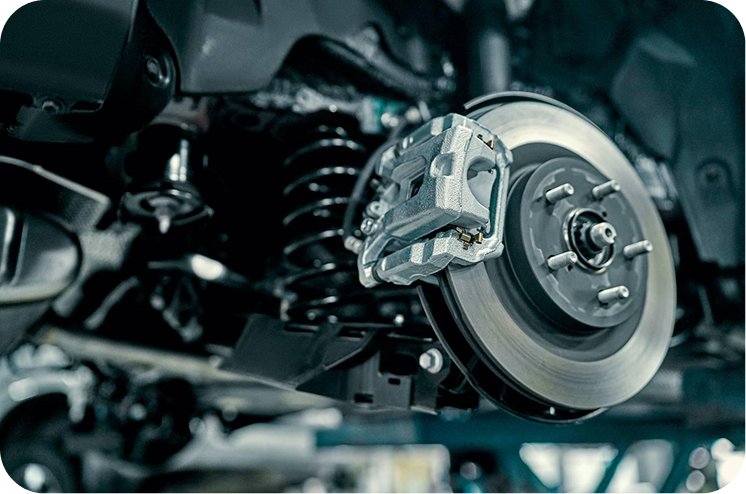
Smart Break Pad Wear Monitor
Potential Applications
1. Motorsport Applications of FBG Sensors
In high-performance motorsport environments, even the slightest changes in structural integrity, aerodynamic forces, or temperature can significantly impact performance. FBG sensors provide real-time measurement of these critical variables, delivering precise data that enables engineers and racing teams to fine-tune vehicle dynamics for maximum efficiency, safety, and competitive advantage.
Key Areas of Application in Motorsports:
Chassis Monitoring: FBG sensors accurately measure dynamic loads and stress points on the chassis during high-speed racing, enabling engineers to refine structural design for improved efficiency and performance.
Suspension and Shock Absorber Analysis: By detecting even the smallest changes in suspension movement, FBG sensors allow teams to fine-tune vehicle dynamics, enhancing control, stability, and handling precision.
Aerodynamic Load Measurement: FBG sensors can be integrated into aero-sensitive components—such as bodywork and wings—to monitor aerodynamic forces in real time, enabling precise adjustments for optimal aerodynamic performance.
Brake System Monitoring: When embedded in brake rotors or calipers, FBG sensors provide critical data on temperature variations and stress levels, helping teams improve braking safety, consistency, and performance under extreme conditions.
2. Renewable Energy: Wind Farms
FBG sensors are integral to modern wind farm operations, offering real-time structural health monitoring of wind turbine blades, towers, and foundations. By detecting strain, temperature fluctuations, and fatigue, these sensors enable predictive maintenance strategies that significantly reduce unplanned downtime. Through early identification of potential failures, FBG technology enhances turbine performance, extends equipment lifespan, and lowers maintenance costs—ultimately making wind energy systems more reliable, efficient, and sustainable.